
About Course
Welcome to Navigation
Know exactly where you are, where you are going, and when you will arrive.
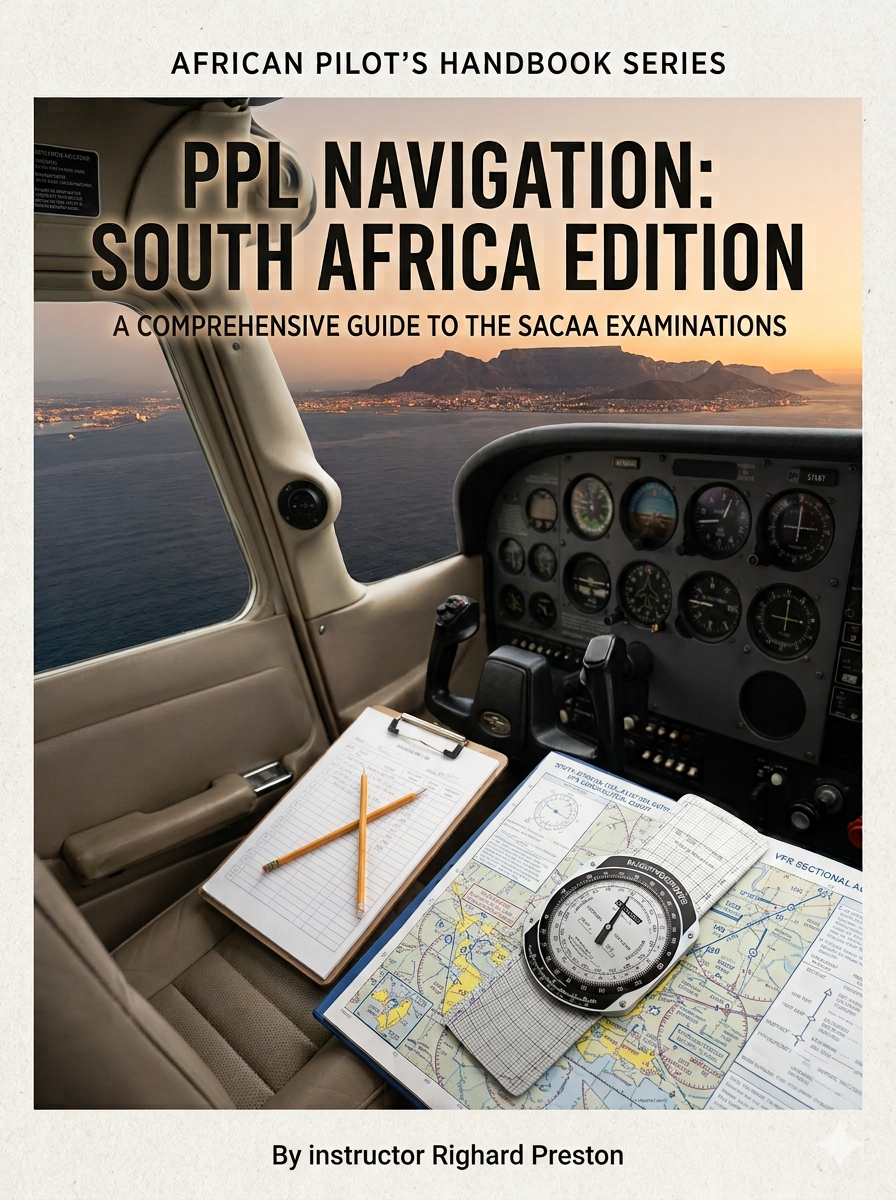
Welcome to the LegendSky Ground School Navigation course. Navigation is the art of answering three questions with confidence: where am I, where am I going, and when will I get there? Every chart, every calculation and every radio bearing in this subject exists to answer one of those three.
It is also the most practical of the SACAA written subjects. You will not simply read about navigation — you will draw tracks, measure bearings with a protractor, step off distances with dividers, and solve wind problems on a navigation computer. The examination expects you to do navigation, not just describe it.
That is why this course is built around practice rather than reading. Every subtopic pairs a video lesson with full written notes and its own set of questions, so you prove you have understood something before moving on to the topic that depends on it.
How This Course Works
Each subtopic follows the same four-step cycle. Complete all four before moving on, and the subject builds naturally.
1. Watch • 2. Read
- Video Lesson: Every subtopic has its own video, walking you through the concepts and demonstrating each calculation method in real time.
- Full Written Notes: Each lesson is backed by complete written material covering the entire syllabus for that subtopic — nothing is left for you to find elsewhere.
- Worked Examples: Every calculation is demonstrated step by step, with the reasoning shown in full, so you learn the method rather than memorising an answer.
3. Test • 4. Prove
- Topic Quizzes: Test your knowledge immediately after each lesson. Retaking a quiz presents all the questions in a newly randomized order, so you cannot pass by remembering the sequence.
- Master Mock Exams: When you are ready, tackle the mock exams. Each attempt pulls a completely fresh, randomized subset of questions to simulate the real testing environment.
- Detailed Feedback: Review the explanation for every incorrect answer, so you understand why it was wrong and never make the same mistake twice.
Why Navigation Rewards Doing the Work
Navigation is cumulative in a way the other written subjects are not. The variation you learn in Aircraft Magnetism reappears in every radio bearing calculation. The wind triangle you master on the navigation computer underpins every flight plan you will ever file. A shortcut taken early does not cost you a mark in that lesson — it costs you three chapters later, when the foundation you skipped turns out to be the thing the question depends on.
The upside is that it works both ways. Students who put the practice in early find the later topics remarkably straightforward, because by then they are only learning one new thing at a time instead of three.
Tips for Success
- Do Not Skip Ahead: Work through the subtopics in the order given. Each one assumes you have completed the one before it, and the quizzes are there to confirm you have.
- Follow Along, Do Not Just Watch: Have your equipment on the desk and work every example yourself as it is demonstrated. Navigation is a physical skill — watching someone else set a navigation computer teaches you very little.
- Master the Navigation Computer Early: Practise until the settings feel automatic. In the examination you should be spending your time thinking about the problem, not remembering which way to rotate the scale.
- Predict Before You Calculate: Before touching the computer, ask yourself whether the wind is ahead or behind, left or right — then check that your answer matches. This one habit catches the majority of setting errors before they cost you a mark.
- Watch the Clock: The official SACAA Navigation examination is strictly timed, and this paper is calculation-heavy. Use the mock exams to practise working accurately under time pressure.
- Mind Your Units and Directions: Most lost marks in Navigation are not conceptual — they are a variation applied the wrong way, a time left in hours instead of minutes, or a distance read off the wrong scale. Slow down on the small stuff.
- Reach Out: If a concept has you stuck, revisit the video, re-read the notes, or ask. Navigation tends to click suddenly once the underlying picture makes sense — do not struggle in silence.
Not ready to enrol yet? Try 10 free Navigation practice questions with full explanations and see how ready you are for the SACAA exam.
Course Content
The Earth
-
The Earth
08:13 -
The Earth Quiz
Aeronautical Charts
Aircraft Magnetism
The Navigation Computer
Practical Navigation
Radio Navigation Aids
Radio Navigation
Navigation Mock
Student Ratings & Reviews