
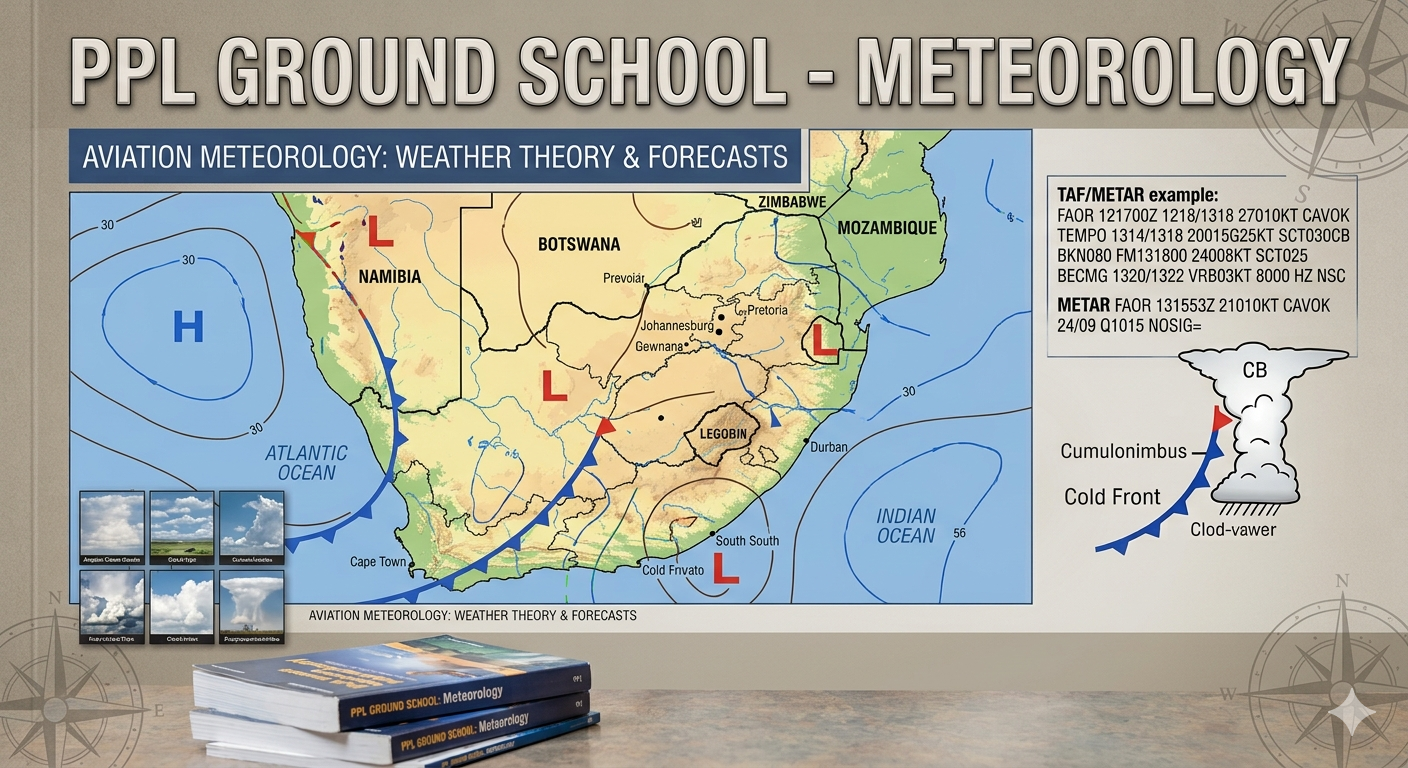
Meteorology

Categories: PPL Ground School
Wishlist Share

About Course

Welcome to Meteorology

Prepare to master the elements and ace your SACAA exam.

Welcome to the LegendSkyGroundSchool Meteorology course! Operating an aircraft safely requires a deep understanding of the dynamic weather systems that govern our skies. This course is structured to break down complex atmospheric principles into clear, manageable lessons so that pilots can forecast conditions, avoid hazards, and fly with absolute confidence.

How This Course Works

Video Lessons

  • Paced Learning: Work through each weather phenomenon and forecast model one at a time.
  • Core Concepts: We highlight exactly what the examiners focus on, from reading synoptic charts to decoding METARs and TAFs.
  • Visual Aids: Complex weather patterns like frontal systems, icing conditions, and thunderstorms are made easy to visualize.

Intensive Quizzing

  • Topic Quizzes: Test your knowledge immediately after each video lesson. Retaking these quizzes will present all the questions in a newly randomized order to test your true comprehension.
  • Master Mock Exams: When you are ready, tackle the mock exams! Each attempt here pulls a completely fresh, randomized subset of questions to simulate the real testing environment.
  • Detailed Feedback: Review the explanations for any incorrect answers to ensure you never make the same mistake twice.

Tips for Success

  • Watch the Clock: The official SACAA Meteorology exam is strictly timed. Use the comprehensive mock exams to practice your time management.
  • Don’t Rush the Details: Pay close attention to specific figures and atmospheric values (e.g., lapse rates, cloud base calculations, and pressure gradients).
  • Reach Out: If a specific weather concept has you confused, revisit the video lesson or reach out for clarification.

Not ready to enrol yet? Try 10 free Meteorology practice questions with full explanations and see how ready you are for the SACAA exam.

Show More

What Will You Learn?

  • Understand fundamental atmospheric processes, pressure systems, and thermodynamics.
  • Identify various cloud formations and predict their associated weather conditions.
  • Decode and interpret standard aviation weather reports and forecasts (METARs, TAFs, SPECI).
  • Understand the formation, life cycle, and aviation hazards of frontal systems.
  • Recognize and safely avoid dangerous weather phenomena like thunderstorms, icing, and fog.
  • Apply meteorological theory to practical, real-world flight planning and decision-making.

Course Content

The Atmosphere
Discover the composition, layers, and fundamental properties of the Earth's atmosphere and how they create the environment we fly in.

  • The Atmosphere
    07:59
  • The Atmosphere Quiz

Temperature
Understand atmospheric heating, temperature variations, inversions, and their direct, critical impact on aircraft performance.

Pressure
Learn how atmospheric pressure is measured, how it drives weather systems, and the vital importance of accurate altimeter settings.

Wind
Explore the forces that create wind, including pressure gradients, the Coriolis effect, and local surface winds critical for takeoff and landing.

Humidity
Understand water vapor in the air, dew point spread, and how moisture content dictates weather development and cloud formation.

Air Density
Master the concept of density altitude and how temperature, pressure, and humidity combine to affect aerodynamic lift and engine power.

Stability, Lapse rate & Adiabatic Process
Decode how air cools as it rises, how to determine atmospheric stability, and how these processes trigger severe weather or turbulence.

Clouds
Learn to identify global cloud classifications, their formation processes, and the specific weather and flight hazards associated with each type.

Precipitation
Explore the different forms of precipitation, how they develop, and their impact on visibility, aerodynamics, and overall flight safety.

Visibility
Understand the atmospheric phenomena that restrict vision, such as fog, haze, and smoke, and learn how to interpret VFR visibility minimums.

Air Masses
Discover how massive bodies of air acquire their temperature and moisture characteristics, and how their movement dictates large-scale weather patterns.

Fronts
Learn to identify cold, warm, and occluded boundaries between air masses, and the distinct, often severe weather sequences associated with their passage.

Thunderstorms
Understand the lethal forces inside cumulonimbus clouds, including their life cycles, severe hazards, and absolute avoidance procedures.

Turbulence
Explore the causes of rough air—from mountain waves to wake vortices—and master the operational procedures for safely mitigating severe encounters.

Icing
Identify the conditions that cause clear, rime, and induction icing, understand their devastating aerodynamic penalties, and learn critical escape strategies.

South African Weather
Master the unique regional synoptic patterns, seasonal shifts, coastal lows, and Berg winds specifically affecting South African airspace.

Synoptics
Learn to read and interpret surface pressure charts, isobars, and station models to visualize large-scale weather systems for cross-country planning.

Aviation Weather reports & Forecasts
Become fluent in decoding alphanumeric METARs, SPECIs, and TAFs to make critical, informed pre-flight and in-flight aeronautical decisions.

Mock Exam

Student Ratings & Reviews

No Review Yet
No Review Yet